Featured Post

Accessing my Friday AM Columns

If you missed past Friday AM columns, I am making them available at this link. https://drive.google.com/drive/folders/1RHBug3PyKzmqHKRS2aF...

Tuesday, March 5, 2019

Nature's Turn

I have written mostly about Victoria's urban life in this blog. It's time to acknowledge the presence of nature here.

It is easy to stroll -- even along the oceanfront -- and not pay attention to the natural world on which we depend. I have been walking with a couple of different groups and find that in the throes of conversation with other people, I miss a lot of things I would normally notice if I was out by myself or with Ken.

Yesterday we sat by the water's edge and watched a Black Oystercatcher through the binoculars. He stood on rocks that were being covered with sluicing water as the incoming tide washed over him, sometimes getting completely soaked. But he seemed unperturbed, scooting around the rocks and grabbing at whatever marine life was clinging to them.

Black Oystercatcher.
Source: www.islandlight.ca/cortes-island-oystercatcher-photo-885
The day before we had watched -- without binoculars -- three animals that appeared to be otters, on rocks far out in the ocean. We initially guessed that they must be sea otters, but now understand that sea otters do not usually come this far south. They must have been river otters.

There are many Mergansers and Bufflehead in the waters along Dallas Road.  We are familiar with these ducks from their spring and summer sojourns in the interior, where they come to breed. It was enjoyable watching their feeding behaviour in salt water.

By contrast, I find the over dense population of Mallards at Beacon Hill Park to be an indicator of something out of balance. The photo below shows that the population is so high, they have eroded all the grass in the area. I saw one Ruddy duck, and a number of American Wigeon, mixed in, but 90% of the ducks are Mallards.

Beacon Hill Park is an urban park, not a natural one, and the experience of these children with the ducks is an encounter more zoo-like than anything.
Feeding ducks at Beacon Hill Park

Look Up! Herons in Douglas fir at Beacon Hill Park
We talked with a photographer who had these herons in his scope. They have just returned; he said these were males.


All these experiences of nature have skated around the most essential point, which is that nature's systems provide the fundamental source for life on the planet.

Some use the term "natural capital" - the services that the earth's ecosystems provide us. It is rather a peculiarly modern way of looking at things, that our ecosystems serve us and that we have to put a dollar quantity on the value of the services that they provide. It is an indicator that we cannot value our environment for its intrinsic benefits, or because we are all part of the web of life. Rather, we have to find a dollar value.


Here is one chart that I found that is oriented to the oceans and the ecosystem services they provide - including food sources, but also filtering water, protecting coastlines, and sequestering carbon:


Source: https://oceanwealth.org/ecosystem-services/

Because we have primarily stayed in the James Bay area on this trip, we have not been to the wilder ocean scenes. Here are a couple from our last trip further up the island.


Natural coastline, Courtenay area

When the tide recedes

Life in the city tends to be very separated from nature. I would like to see much more awareness and connection - even in this most "green" of cities.


Friday, March 1, 2019

Diversions

Before I talk about my thoughts on resilient communities, here is a diversion for a bit of fun: James Bay's Window Wanderland which happened last weekend. Through decorating windows with translucent designs, the neighbourhood was transformed with colourful windows. At night, these shone like stained glass, with the lights behind them.

This was the second year in a row that the community has had a Window Wanderland. There were workshops, with materials provided, at one of the community centres, for people to make their own creations.

We saw some of the designs, but missed many. The map below shows how many homes and facilities "lit up".

The New Horizons Centre served hot chocolate in the evenings for people to warm up and gather. We did not go to that; I spoke to a couple who had been and asked how many were there when they stopped by, and they said, "a few".

The concept of Window Wanderland is an import from an idea in the UK. Here is a website with more info: https://www.windowwanderland.com/

Because it is a new idea, like all news ideas, it will take some time to catch on and spread. But it is a great one.
Map of known participants in Window Wanderland
James Bay United Church had a big display, building on two lines from the hymn "All Things Bright and Beautiful":

James Bay United Church Windows

And here is one example of what people in an apartment building did:


Add caption


This is from the "sail" that neighbours walking on the street were encouraged to pull or move, to get the various wind chimes ringing.
I called this posting a "diversion" - but ultimately, community events like this are a key component to building a resilient community.

The website promoting the idea describes the objectives as "to build relationships, strengthen neighbourhoods, create pride and spread friendship, positivity, happiness and goodwill."  

What could be better?


Tuesday, February 26, 2019

Of Cars and Bikes, Chickens and Ducks


Living in downtown Victoria it is possible to go car-less. We used ours the first day we arrived, to get groceries, and have not moved it since.

Between walking and public transit - and bicycles if we had them here - we do not need a vehicle.

We have met many people who have chosen to go carless, including one couple who live in Vancouver and came to Victoria via public transit for a weekend cultural getaway to take in the opera and two plays. They even brought much of their own food for the weekend, in suitcases!

Going without a car is not a hardship for the people we have talked with; rather, they are enthusiastic about it. They enjoy the cost savings, the hassle-free nature of their lives, and the enjoyment and healthy living they get from walking and cycling.

For trips out of town, they use public transit or rent a vehicle if it is absolutely necessary.

Year-round cycling is a feature of life in Victoria. Here is an iconic image that the Times-Colonist published during the big snows earlier this month:

Source: Victoria Times-Colonist


Victoria is going all-out to expand its network of separated bike lanes, fast-tracking 35 km of separated bike lanes in the next three years. This decision has been controversial, as in some cases, roadway or parking capacity is being reduced. 

There is also a rumour that cherry trees are being removed to make bike lanes, but it seems that this has been overblown. The issue of loss of cherry trees has more to do with planting drought-resistant native species, to adapt to climate change, than it has to do with bike lanes. The mayor talks more about this in a recent post on her blog.  https://lisahelpsvictoria.ca/2019/02/25/cherry-trees-urban-forest-management-and-climate-change-the-facts/

Fort Street Separated Bike Lanes.
Notice the two-way markings, the barriers separating bikes from traffic,
and the green markings for intersections.


Navigating these bike lanes can be challenging for cyclists, pedestrians, and drivers, especially the process of turning. I watched a YouTube video that explained it, and I was confused. There is definitely a learning curve involved. 

But in the long term, road safety will be much improved, especially for cyclists. And that is the aim! The risks of cycling in traffic have definitely prevented me from enjoying riding my bike on busy roads.

If we are to successfully reduce private vehicle usage in cities, alternative modes of transport, like walking, cycling and public transit, must be attractive and seamless.

The first North American roll-out of U-bicycles was in Victoria, in 2017. These are a dockless rental bike that is based on a barcode stamped onto the bike's locking mechanism. An app allows users to rent them and leave them anywhere.

U-Bicycle in Victoria


Helmets are included with the bike rental

Projects like this will contribute to reducing our dependency on private automobiles. 

Over ten years ago, the phrase "Climate Code Red" described the emergency that we are facing globally as a result of climate change. 

The authors compare our current situation to that of World War II, when the economy diverted a huge percent of spending to the war effort. 

They argue that we must make similar investment decisions now, to prevent the worst effects of climate change. 

That was over a decade ago, and we have not yet stepped up to make those tough decisions. The time is now!

Part of the ability to move away from private vehicles is for communities to become much more self-reliant. "Resilient community" is one of the terms I have heard to explain this. 

One aspect of resilience is food self-sufficiency, or "sustainable" local food. This involves supporting local food production, buying locally for example. 

In James Bay, I have encountered a couple of folks who are going far beyond herbs in pots or raised vegetable beds. Two of the more well-known are Chris and Susannah Adams, who describe themselves as "urban farmers".

The home of Chris and Susannah Adams on Battery Street

The James Bay Beacon, a community newspaper, has published a couple of articles about the Adams, in 2013 and again in 2016: http://www.jamesbaybeacon.ca/?q=node/1086 and http://jamesbaybeacon.ca/?q=node/1952

We walk by the Adams place regularly, and have chatted with Chris a few times. He has taught himself much about organic farming and how to develop integrated farming systems. For example,  Welsh Harlequin ducks - a heritage breed which is hard to find - provide rich eggs high in protein and fat. They are productive; one duck laid 300 eggs in a year. They also perform important work on the farm, eating slugs which accumulate under the mulch that Chris and Susannah use to protect their crops. 

Welsh Harlequin Ducks in James Bay
Chris is also an advocate for native plants, and is experimenting with a bed that has some of the plants which grow in Garry Oak meadows which used to be so widespread on southeastern Vancouver Island. 

Garry Oak meadow, Uplands Park, Victoria, with Camas in bloom.
Source: http://www.goert.ca (Garry Oak Ecosystems Recovery Team)
One of the plants Chris is growing is Camas, a beautiful blue flower with an edible bulb which was a staple of the local First Nations diet. The picture to the left shows a remnant of this native ecosystem.


The photo below shows more detail of Chris and Susannah's farm. Notice the raised beds, made of ferrous concrete.
Chris made the material for the raised beds from ferrous concrete, finished with an iron oxide pigment.
The closest bed has been planted with Camas bulbs, native to this area, as well as a filbert tree.
Ken was very interested in the raised beds made of ferrous concrete, and researched the process. Here is one link:  https://www.youtube.com/watch?v=fzAOAWQb_hY

As well as ducks, Chris and Susannah have chickens, in this case, a hybrid chicken known as the ISA brown (ISA for the French company which originally developed the hybrid).

ISA chickens are known for being productive egg-layers 

We have seen chickens elsewhere in James Bay. Sustainable local agriculture is one part of a resilient community. I will write in my next post about other components of resilience.


Thursday, February 21, 2019

The Science, Politics and Optics of Sewage

There has been a lot written about Victoria's sewage treatment - or rather, the lack of it.

Thanks to a very effective public campaign by those who have been horrified that Victoria does not treat its sewage before discharging to the ocean, the Capital Regional District, and the City of Victoria in particular, are now in the midst of a major construction project.

Scheduled for completion in 2020 the project will result in sewage being piped from where it is presently discharged into the ocean, along Dallas Road, to a forcemain at Clover Point, thence undersea to a new treatment plant being built in Esquimalt for tertiary treatment. Part of the plan also involves the creation of biosolids from the treatment which will be available for re-use.

The construction is evident all along Dallas Road and some of the adjacent intersecting roads.

Dallas Road construction, February 2019

Ken checking out the pipe stacked along Menzies Street

More information about the details of the whole project are available at https://www.crd.bc.ca/project/wastewater-treatment-project

One of the reasons the campaign for treatment was effective was Mr. Floatie, seen here at City Hall:


I have been aware of Mr. Floatie for many years, and used him as an example of effective public marketing in a number of presentations I did over a decade ago. His "Coming Out" party at Earth Day in 2004 was launched with a press release with some memorable scatological humour, and catchy phrases. He represented the group P.O.O.P. (People Opposed to Outfall Pollution) as their official "spokesturd".

Extract from P.O.O.P. Press Release, April 24, 2004

Mr. Floatie's slogan "Dilution is not the Solution to Victoria's Pollution" rang strongly with Victoria's citizens.

My interest has been piqued recently because there were many scientists who argued that the project was not necessary, and that resources would be more effectively spent in other ways.

See the website http://www.rstv.ca/  which argues that "there will be no significant benefit to the marine environment for this vast expenditure of public funds".


Two conflicting messages. One, much catchier than the other, and that was the one that captured public opinion.


In the case of Victoria's sewage, it is likely that no matter what scientists said, the optics of Victoria discharging raw sewage into the ocean would lead to pressure for treatment. 


The scientists who banded together to argue that sewage treatment was unnecessary lost their battle. Perhaps their website is too wordy, reading too much like research papers. How can words argue with Mr. Floatie?


Mr. Floatie was an effective image in the campaign for sewage treatment.
Here he is on his way to his "retirement" party. (Source: CBC)

At the global environmental scale we need more Mr. Floaties. We need advocates to be clear about the urgency for action, and we need decision-makers to take tough actions on climate change. 

We need to market action on climate change, just the way Mr. Floatie marketed action on sewage treatment for Victoria.


Tuesday, February 19, 2019

Victoria's Post-European Settlement History

The first time we walked downtown we saw the deep hole by the Visitors' Centre. And it is a DEEP hole!
Customs House Redevelopment, Victoria


This development is going to be a fancy, upscale residential one, called "Customs House".

There is some information on the website customshouse.ca which refers to the three "grand dames" of Victoria's inner harbour: the Empress Hotel, the BC Legislature, and the Customs House.

The building was constructed in 1914, and housed the federal customs offices. It was built on the granite foundations of the 1898-built Post Office, and was designated a heritage building in Victoria.

The walls that can be seen in the background are staying, and are going to be incorporated into the new development.

Photos below show the lengths which have been taken to keep the walls from tumbling down.


Customs House Wall, from back


Redevelopment showing the sign for the Presentation Centre
An article in the Victoria Times Colonist from February 2018 says the redevelopment is costing the developer $28 million. At that time, units were reported to be selling between $1.6 and $3 million, but sale prices are probably greater than these.

There was considerable controversy over the fact that the City has given purchasers of units a 10 year "tax-holiday" estimated to be costing the City over $5 million.

The justification is that it is part of the City's program to "stabilize" its heritage buildings. Any renovations must include seismic upgrading (Victoria is in an earthquake zone). The seismic upgrading for the Customs House development will exceed $6 million for the developer.

Here is a photo I found on the internet of the original Customs House:


Looking into the Customs House and its significance historically triggered a few more thoughts about our history - in this case, post-European settlement history.

Walking downtown and James Bay certainly provides a sense of the past, more so than in a newer community such as Salmon Arm. Emily Carr spent most of her life in Victoria, and her presence is here.

Statue honouring Emily Carr, with Empress Hotel in the background

Emily Carr house, Government Street. Carr was born here and
lived most of her life in the James Bay neighbourhood.
I have shown a few images of some of James Bay's older houses in an earlier posting. There are many more! Here is a small sample:


The City has done an excellent job of acknowledging and protecting heritage - despite the (partial) loss of some buildings such as Customs House. There are heritage walking tours through many of the old neighbourhoods, and a substantial 4 volume set of coffee table books called "This Old House" which focusses on the heritage of twelve neighbourhoods, including James Bay.

A visitor interested in focussing on Victoria's post-European settlement history should definitely check out this site: https://victoriaheritagefoundation.ca/


The apartment building we are staying in, Beacon Lodge, was built the year after Emily Carr died, 1946, by the Coté family, Francophones who had moved to Victoria from Edmonton. Apparently the octagonal windows are a feature of the Art Deco movement of the time. Originally it was a guest house, but was converted to apartments in the 1970's.


The most charming thing for me about the building is not its construction, but the plaque in the foyer: 


This is so apropos for me -- I see myself as a friend of nature, always seeking beauty, rest and contentment.

Definitely I am in the right place!


Sunday, February 17, 2019

Victoria Potpourri

In the last week, interspersed with snowstorms, I have experienced the richness of urban life, all within walking distance of our abode.

Talks, a poetry reading, a writers' group, coffee conversations and discussion groups provided the intellectual component.

We participated in a most interesting conversation group at the James Bay Coffee Company, at a regular weekly group associated with the Unitarian church that meets at New Horizons Centre in James Bay. This group discusses random topics which are selected at the time; there is a bit of loose format which helps the discussion not get bogged down.

This time the topic was truth and knowledge, suggested by someone who has been reading the book Post-Truth. I enjoyed the thoughtfulness of the participants, and the breadth of points raised. It was a good example of "group mind" in action.

Post-Truth was released last year, and traces the development of the conditions in our democracy leading to the situation that we have now, where the phrase "alternative facts" is an acceptable one, and where leaders lie.

The discussion was so stimulating that right afterwards we walked downtown to the library and found a copy of the book, which we borrowed using our BC One Card. (This is a wonderful service whereby users of one library system like the Okanagan Regional Library can register for another library system and have access to their materials.)

I am now part-way through the book. The last chapter is titled "Fighting Post-Truth". I will report on the author's ideas after I have read it.


We have walked many kilometres in the James Bay, Inner Harbour and downtown areas. Walks on the streets and in the park provided fresh air (sometimes, REALLY fresh when the wind was howling!) and visual stimulus and beauty.


On Valentine's Day I came across this on a park bench. Yes, it is all about "Love, love, love." If we acted out of love, instead of fear, how much different our world would be. It is a constant meditation for me, letting go of fear and embracing love.

A message for every day, all year -- love


A few of the snow-bound scenes I encountered in my wanderings:

Beacon Hill Park


Arbutus, the only broadleaf evergreen in Canada, usually growing within 1 1/2 km of the ocean


Along Dallas Road


Pond at Beacon Hill Park

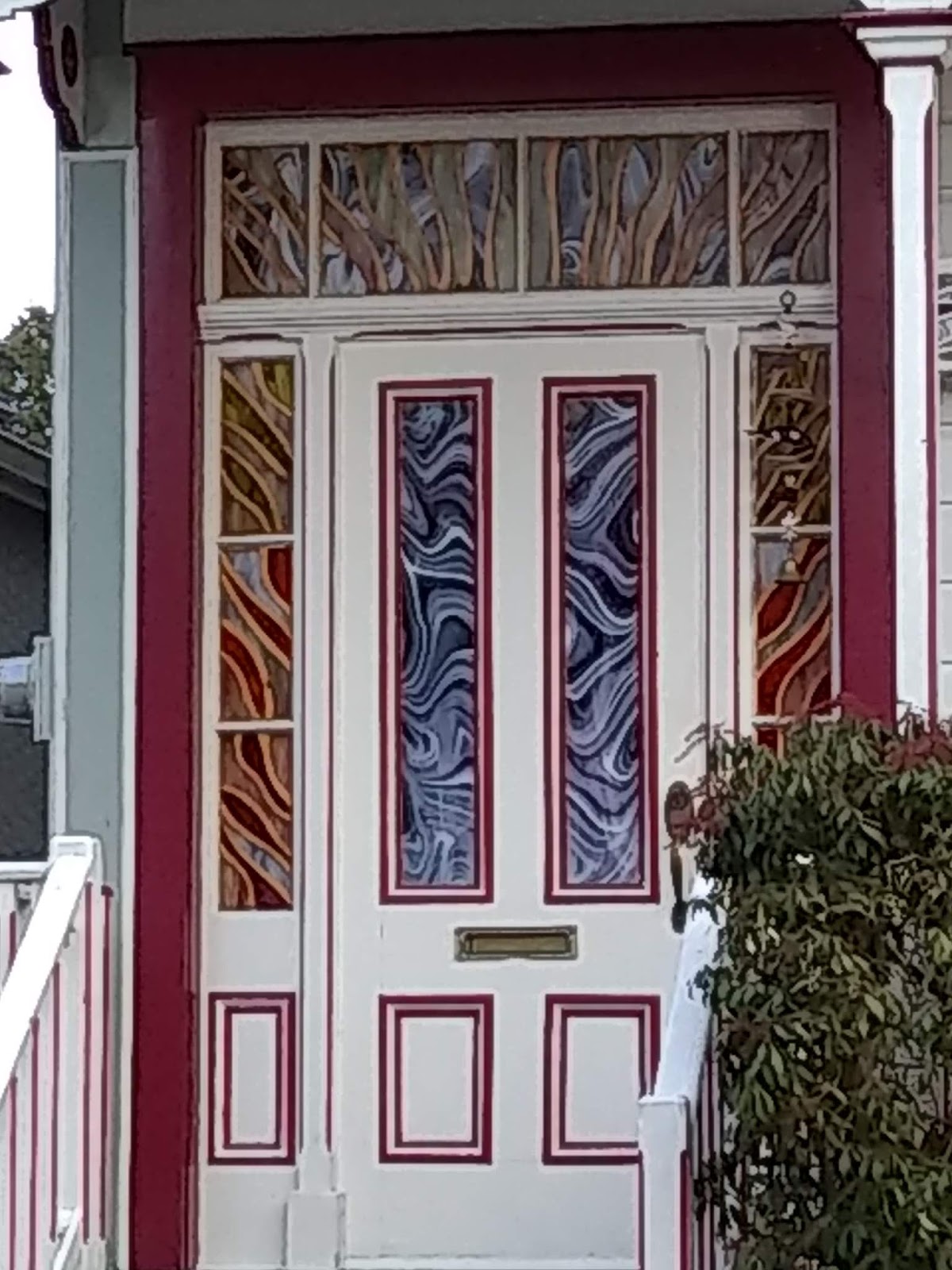
Here is a house with an amazing stained glass door, located on Government Street.


And, some different types of "public art".

Terry Fox Memorial at Mile 0,
where he started his Marathon of Hope
Lots of snowmen around town!


Finally, I love this piece of public art in Beacon Hill Park. She has a quiet peacefulness to her ... earth goddess, spirit of the forest.

Sleeping Moss Lady

Peace be with you all.